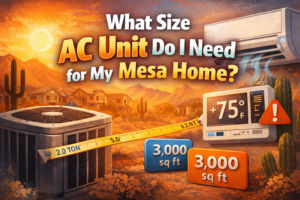
 Choosing the right AC size isn’t just about comfort — it affects your energy bills, indoor air quality and how long your system lasts. In Mesa, AZ, where summer temperatures often soar above 110°F, the wrong size air conditioner can struggle, waste energy, or break down early.
If you’re thinking for replacing your system or Installation of ac in mesa , this guide will help you understand exactly what size AC unit you need — and why it matters.
Overview
The right AC size depends on your home’s square footage, insulation, layout and Mesa’s extreme heat. An oversized unit wastes energy. An undersized one runs constantly. A professional load calculation ensures proper cooling, lower bills, and longer system life in Arizona’s climate.
What Does “AC Size” Actually Mean?
When we talk about AC size, we’re not referring to physical dimensions. We’re talking about cooling capacity, measured in tons or BTUs (British Thermal Units).
-
1 ton = 12,000 BTUs per hour
-
Most Mesa homes need between 2 to 5 tons
-
The average 2,000 sq ft home often needs about 3–4 tons (depending on insulation and sun exposure)
But square footage alone is not enough.
Professional AC sizing uses something called a Manual J Load Calculation, which looks at:
-
Home size
-
Ceiling height
-
Insulation levels
-
Number of windows
-
Sun exposure
-
Ductwork condition
-
Number of occupants
Skipping this step is one of the biggest mistakes homeowners make.
Why AC Size Matters in Mesa, AZ
Mesa summers are brutal. Areas near Sloan Park, Falcon Field Airport, and neighborhoods in 85205 and 85206 regularly see intense sun exposure and dry desert heat.
An improperly sized AC system can:
-
Run nonstop and never cool properly
-
Spike your electricity bills
-
Wear out compressors early
-
Create uneven cooling between rooms
-
Struggle during 110°F+ days
Arizona heat pushes systems harder than almost anywhere in the country. Proper sizing isn’t optional here — it’s essential.
What Happens If Your AC Is Too Small?
An undersized unit will:
-
Run constantly without reaching set temperature
-
Struggle during peak afternoon heat
-
Cause higher energy bills
-
Experience premature breakdowns
You may notice warm rooms in parts of your house, especially upstairs areas in Mesa homes with high ceilings.
What Happens If Your AC Is Too Big?
Bigger is not better.
An oversized AC will:
-
Turn on and off frequently (short cycling)
-
Fail to remove humidity properly
-
Increase wear and tear
-
Reduce system lifespan
-
Waste electricity
Short cycling is especially common in newer homes in 85207 and 85202 where insulation is strong but systems were oversized “just to be safe.”
Common AC Sizing Mistakes Homeowners Make
-
Using square footage alone
-
Replacing with the same size without testing
-
Ignoring ductwork condition
-
Not accounting for Mesa’s climate
-
DIY online calculators without local adjustment
Arizona’s desert climate changes cooling needs significantly compared to other states.
How to Determine the Right AC Size
Step 1: Measure Your Home Properly
Accurate square footage is just the starting point.
Step 2: Evaluate Insulation & Windows
Older homes in 85204 and 85205 often have less efficient insulation, which increases cooling load.
Step 3: Assess Sun Exposure
South- and west-facing homes in Mesa absorb serious afternoon heat.
Step 4: Schedule a Professional Load Calculation
A licensed technician performs a full Manual J calculation to determine exact tonnage requirements.
This is the safest and most accurate method.
Pro Tips for Mesa Homeowners
🔹 Don’t Guess Based on Your Neighbor
Even identical floor plans cool differently depending on upgrades and sun exposure.
🔹 Upgrade Insulation Before Upsizing
Improving insulation may allow a smaller, more efficient system.
🔹 Consider Energy Efficiency (SEER Rating)
High-efficiency units handle Mesa heat better and reduce monthly bills.
🔹 Check Your Ductwork
Leaky ducts can make a properly sized AC feel too small.
Mesa Climate: Why It Changes Everything
Mesa isn’t just hot — it’s intensely dry and sun-exposed. In zip codes like 85205 and 85206, long stretches of triple-digit heat push AC systems to their limits.
Homes near Mesa Arts Center and older neighborhoods may have aging ductwork or insulation that increases cooling demand. Meanwhile, newer builds in 85207 often have tighter construction but larger open floor plans.
Because of our desert climate:
-
AC systems run longer
-
Proper airflow is critical
-
Heat load is higher than national averages
-
Equipment durability matters more
A system sized for another state may fail here.
When to Call a Professional
Call an AC expert if:
-
You’re replacing your system
-
Rooms are unevenly cooled
-
Your AC runs constantly
-
Energy bills keep rising
-
Your unit is over 10–12 years old
Incorrect sizing during replacement is one of the top causes of repeat AC repair in Mesa.
For trusted help, visit our main website:
👉 https://acrepairmesaaz.com/
Explore our AC services here:
👉 https://acrepairmesaaz.com/services/
Or schedule an inspection today:
👉 https://acrepairmesaaz.com/contact/
FAQ
How many tons do I need for a 2,000 sq ft home in Mesa?
Most homes that size need 3–4 tons, but insulation, layout, and sun exposure can change that.
Is it better to oversize an AC in Arizona?
No. Oversized units short cycle, waste energy, and wear out faster.
How long does a Manual J calculation take?
Usually 60–90 minutes during a professional evaluation.
Can wrong AC size increase my energy bill?
Yes. Both undersized and oversized systems can significantly increase monthly costs.
Does ductwork affect AC sizing?
Absolutely. Poor ducts can reduce airflow and impact performance.
Conclusion
Choosing the right AC size for your Mesa home isn’t about guessing — it’s about precision. With Arizona’s extreme heat, proper sizing protects your comfort, your wallet, and your system’s lifespan.
If you’re unsure whether your AC is the right size, AC REPAIR MESA AZ is here to help.
📞 Call +16029629477 today for a professional assessment and expert AC Service in Mesa (85202, 85204, 85205, 85206, 85207).
Stay cool. Stay comfortable. Stay ahead of the heat.